
What is HRDF in Malaysia and Why It Matters
The Human Resources Development Fund (HRDF), now managed by HRD Corp, is a government-backed initiative under the Pembangunan Sumber Manusia Berhad Act 2001. Its main purpose is to support employee training and upskilling by allowing employers to claim back training expenses.
Through this system, employers contribute a monthly levy which can later be used to fund approved training programmes. This makes HRDF not just a compliance requirement, but also a strategic tool for business growth.
For employers, HRDF helps reduce training costs while improving productivity and staff retention. For employees, it provides opportunities to gain new skills, certifications, and career advancement.
HRDF Registration Requirements in Malaysia
Understanding HRDF registration requirements Malaysia is essential to ensure compliance and avoid penalties.
Companies are required to register with HRD Corp if they meet the following criteria:
- Businesses with 10 or more Malaysian employees must register (mandatory)
- Businesses with 5 to 9 employees may register voluntarily
Most industries, including services, manufacturing, and professional sectors, fall under HRDF coverage.
The registration process typically involves submitting company documents such as SSM registration, EPF statements, and company profile through the HRD Corp e-TRiS portal.
Failing to register when required can result in fines or legal consequences under Malaysian law.
HRDF Levy Contribution and Payment Guidelines
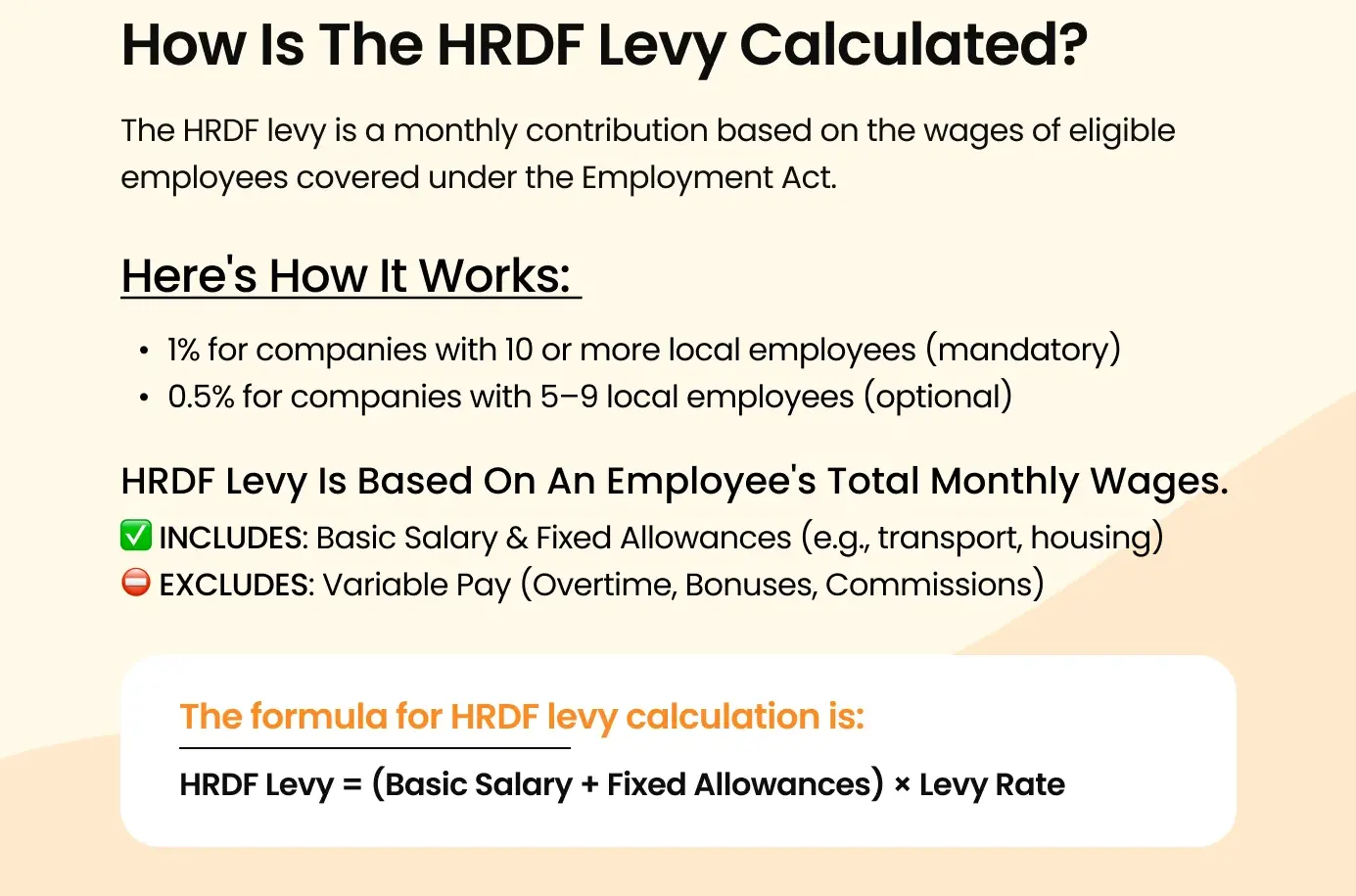
The HRDF levy contribution rate Malaysia depends on company size and is calculated based on employees’ monthly wages.
- Employers with 10 or more employees: 1% of monthly wages (mandatory)
- Employers with 5–9 employees: 0.5% (optional)
Wages include basic salary and fixed allowances such as transport or housing allowances.
Employers must ensure HRDF payment deadline Malaysia compliance by submitting contributions before the 15th of the following month. Late payments may result in penalties, surcharges, or suspension of claims.
Proper payroll tracking and timely submission are essential to maintain eligibility for claims.
HRDF Claim Process for Employee Training
One of the key benefits of HRDF is the ability to recover training costs through the HRDF claim process Malaysia.
To claim training expenses, employers must:
- Apply for training approval through the e-TRiS portal before the training begins
- Select HRD Corp-approved training providers
- Conduct the training programme
- Submit claims with supporting documents such as attendance, receipts, and evaluation forms
Claims typically include course fees, trainer fees, training materials, and even accommodation if applicable.
Employers must submit claims within the required timeframe (commonly within 30 days after training) to avoid rejection.
Common HRDF Compliance Mistakes and Penalties

While HRDF offers many benefits, non-compliance can lead to costly consequences. Understanding HRDF compliance Malaysia helps businesses avoid unnecessary risks.
Common mistakes include missing payment deadlines, submitting incomplete claims, using unapproved training providers, and failing to update employee records.
Penalties may include:
- Rejected claims
- Financial penalties or late charges
- Suspension of training claims
- Legal action for serious non-compliance
To stay compliant, companies should assign a dedicated HR or finance personnel to manage HRDF processes and ensure all submissions are accurate and timely.
Benefits of HRDF for Employers and Workforce Development
The benefits of HRDF for employers go beyond cost savings. It plays a crucial role in long-term business sustainability.
HRDF allows companies to invest in structured training without bearing the full financial burden. This leads to improved workforce competency, higher productivity, and stronger employee engagement.
Additionally, businesses that actively utilise HRDF are better positioned to remain competitive in evolving industries by continuously upgrading their workforce skills.
For employees, HRDF enhances career development through continuous learning and certification opportunities, contributing to higher job satisfaction and retention.
A Complete Guide to HRDF in Malaysia for Employers