
What is Form vs Section in Malaysia?
The terms Form vs Section refer to the differences in company documents issued under two different Malaysian company laws.
Under the old Companies Act 1965, company documents were commonly referred to as “Forms.” After the implementation of the Companies Act 2016, these documents were replaced or renamed as “Sections.”
This change was introduced as part of Malaysia’s effort to modernise corporate regulations and simplify company administration.
Understanding whether your company uses Forms or Sections depends on when the company was incorporated.
Companies Act 1965 vs Companies Act 2016
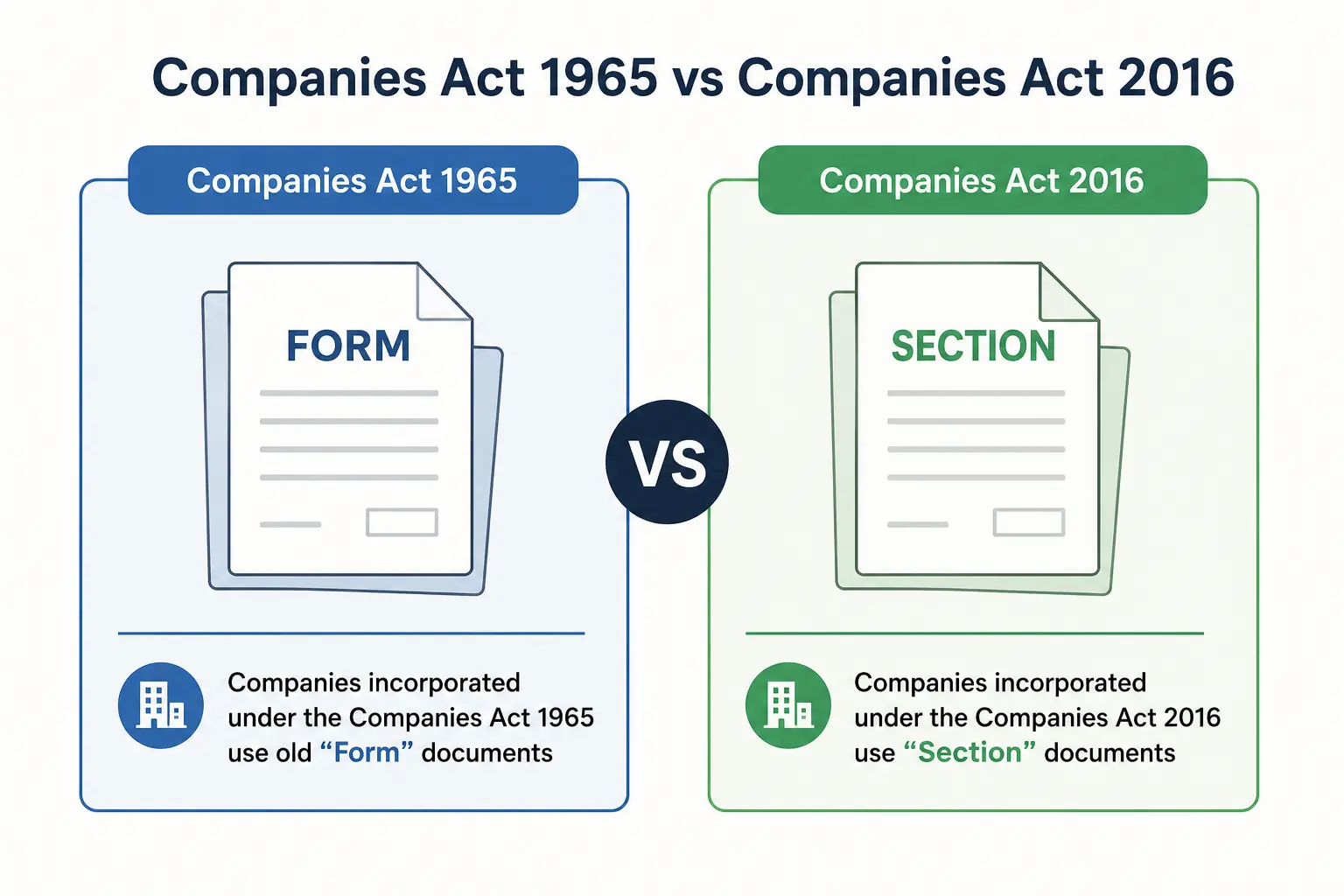
The distinction between Companies Act 1965 vs Companies Act 2016 is important because both laws use different document references.
- Companies incorporated under the Companies Act 1965 use old “Form” documents
- Companies incorporated under the Companies Act 2016 use “Section” documents
For example:
- Form 9 became Section 15 and Section 17
- Form 44 became Section 14 and Section 46(3)
- Form 49 became Section 58 and related sections
Because of this transition, many businesses still encounter both terms when dealing with SSM records and company secretarial matters.
Common Form vs Section Comparison
Understanding the common Form vs Section comparison helps businesses identify equivalent company documents under the new law.
Some of the most common changes include:
| Companies Act 1965 | Companies Act 2016 |
|---|---|
| Form 9 | Section 15 & Section 17 |
| Form 44 | Section 14 & Section 46(3) |
| Form 49 | Section 58 |
| Form 13 | Section 28 |
| Form 24 | Section 78 |
| Form 32(A) | Section 105 |
The Certificate of Incorporation previously known as Form 9 is now replaced by Section 15 and Section 17 documents.
Similarly, the Notice of Situation of Registered Office previously issued under Form 44 is now reflected through Section 14 and Section 46(3).
Why Understanding Form vs Section Matters
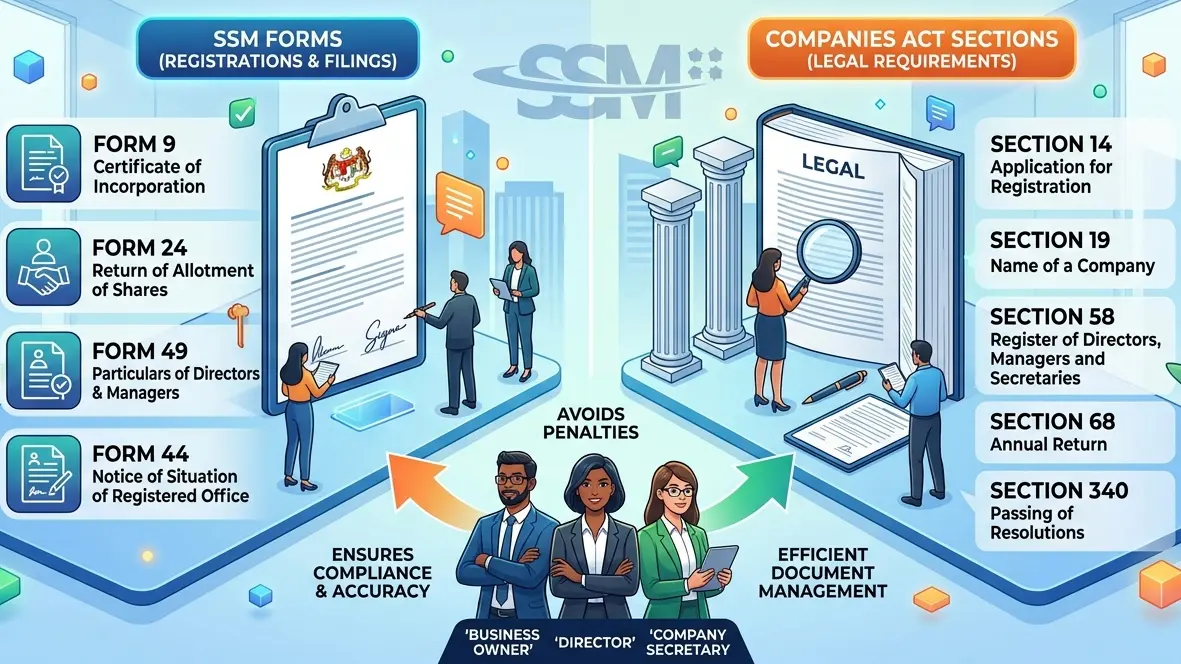
Knowing the difference between Forms and Sections is important for businesses, directors, and company secretaries handling SSM documentation.
This knowledge helps businesses:
- Identify the correct company documents
- Understand old and new document references
- Avoid confusion during compliance and filing
- Improve communication with banks, auditors, and authorities
Many older companies still use historical Form references, while newly incorporated companies primarily use Section references.
Understanding the transition also helps businesses manage corporate records more effectively.
Common Challenges and Best Practices

One of the most common issues businesses face is confusion when comparing old SSM documents with new Section references.
For example, companies may not realise that Form 49 is now replaced by Section 58 documentation under the Companies Act 2016.
To avoid confusion, businesses should:
- Keep updated records of old and new document references
- Consult company secretaries when necessary
- Use updated Companies Act 2016 terminology
- Maintain proper documentation for compliance purposes
By understanding the Form vs Section transition, businesses can manage corporate compliance more efficiently.
Form vs Section in Malaysia: Understanding SSM Document Changes